Primary Reserve and Grid Frequency

Every second, the electricity grid must produce exactly as much power as is being consumed. When it does not, the grid frequency deviates from its nominal value, 50 Hz in eastern Japan and 60 Hz in the west, and the grid operator procures a family of services called ancillary services to bring it back. Since April 2024 the fastest of these services, the primary frequency control reserve (FCR), has been bought on Japan’s balancing market, run by the Electric Power Reserve eXchange (EPRX), and batteries have become one of its main suppliers.
This article explains what grid frequency is, what the balancing market buys and why it was created, and how the primary frequency control reserve product works for a battery. It then estimates how much energy the battery needs to provide FCR, which depends on the real-time frequency deviations and is important information for the battery operator.
Frequency, the grid’s balance indicator
An alternating-current (AC) grid is a single, synchronous machine. Every conventional generator in the grid spins synchronously at a speed that corresponds to the grid’s nominal frequency. If, at any moment, consumption exceeds generation, the missing energy is drawn from the rotating mass of those machines: they slow down, and the frequency falls. If generation exceeds consumption, they speed up and the frequency rises. Frequency is therefore not just a technical parameter but the grid-wide, real-time measure of the supply–demand balance.
Keeping the frequency close to the nominal value is the job of a layered set of controls of increasing response time. The first layer of control that absorbs the smaller faster frequency deviations is the physical inertia of these spinning masses themselves. This is called the grid inertia. For larger frequency deviations, the TSO procures ancillary services from generators to actively adjust their generation to compensate the deviations. These range from the automatic (offline) adjustment of a generator reacting locally within seconds (primary reserve) to the dispatch centre redistributing output over an hour. Historically all of them came from large thermal and hydro plants.
For practical purposes, the frequency is allowed to move within a tolerance: the operational target in most zones is ±0.2 Hz around the nominal value (±0.3 Hz in Hokkaido), with an aim of staying within ±0.1 Hz nearly all the time. Larger deviations trigger the disconnection of generators to avoid damaging them. In the case of a negative deviation, this can in the worst case cascade into a blackout, as happened across the whole of Hokkaido in September 2018 after an earthquake took out a large power plant.
As large centralized fossil generators like coal, oil and gas plants retire, the grid needs new sources for each of these control layers. Solar and wind, which represent a growing share of generation, have no rotating mass and no governor, so this job is more and more done by distributed batteries, and the balancing market provides the mechanism to pay them.
Japan’s grid is unique in running two frequencies: Tokyo’s first generators, imported from Germany in the 1890s, ran at 50 Hz, while Osaka’s came from the United States and ran at 60 Hz. By the time unification was considered, the two systems were too large to convert. The halves are connected only through frequency converter stations with a combined capacity of 2.1 GW, so for balancing purposes they are almost separate grids.
Ancillary services and the balancing market
Ancillary services is the collective name for the products a transmission system operator (TSO) buys to keep the system stable: frequency control, voltage support, black-start capability and others. In Japan the balancing capacity for frequency control is called chōseiryoku (調整力), and it is bought in five products, each defined by how fast a resource must respond and for how long it must sustain its response.
| Product | Japanese name | Command | Response time | Duration | Introduced |
|---|---|---|---|---|---|
| Primary reserve (FCR) | Ichiji chōseiryoku (一次調整力) | offline, local frequency measurement | within 10 s | 5 min or more | April 2024 |
| Secondary reserve 1 (S-FRR) | Niji chōseiryoku 1 (二次調整力①) | online, load-frequency control (LFC) signal | within 5 min | 30 min | April 2024 |
| Secondary reserve 2 (FRR) | Niji chōseiryoku 2 (二次調整力②) | online, economic dispatch (EDC) signal | within 5 min | 30 min | April 2024 |
| Tertiary reserve 1 (RR) | Sanji chōseiryoku 1 (三次調整力①) | online, economic dispatch (EDC) signal | within 15 min | 30 min | April 2022 |
| Tertiary reserve 2 (RR-FIT) | Sanji chōseiryoku 2 (三次調整力②) | online | within 60 min | 30 min | April 2021 |
Table 1. The five products of Japan’s balancing market. Every product is traded in 30-minute slots with a minimum bid of 1 MW in 1 kW steps. Only the upward direction (adding supply when the frequency is low) is procured at present. LFC is the dispatch centre’s minute-scale output signal; EDC its slower, cost-based redistribution of output between plants. Source: EPRX product requirements, 6th edition, March 2026.
A short history
Until the mid-2010s each vertically integrated utility supplied its own balancing capacity from its own plants; there was no market and no price. After the reforms that followed the 2011 earthquake, the transmission operators began buying balancing capacity through annual public tenders (chōseiryoku kōbo, 調整力公募) from October 2016, open in principle to independent suppliers. The balancing market opened on 1 April 2021 to replace the tenders with a common, cross-regional marketplace operated by EPRX, and was introduced product by product: tertiary reserve 2 in 2021, tertiary reserve 1 in 2022, and the primary and secondary reserves in April 2024. The fast products were initially traded one week ahead, in three-hour blocks; from 13 March 2026 all products moved to day-ahead trading.
Prices are capped. The cap on the fast products was set at ¥19.51 per kW per 30-minute slot in 2024, cut to ¥15 in early 2026 alongside the move to day-ahead trading, and cut again to ¥10 from 1 September 2026. The reason is visible in the clearing history below: in the first two years, the primary reserve market in several areas cleared at or near the cap most of the time.
The primary reserve offline
The primary reserve is the product best suited to batteries, and the only one that can be delivered offline: without a telemetry or command link to the TSO. The battery measures the grid frequency at its own connection point (jihashi seigyo, 自端制御, “control at one’s own terminal”) and adjusts its power automatically. The market rules require it to begin responding within 2 seconds of a frequency change, to reach the required output within 10 seconds, and to sustain it for at least 5 minutes. This is easy for a battery, which generally has sub-second response times.
The response rule
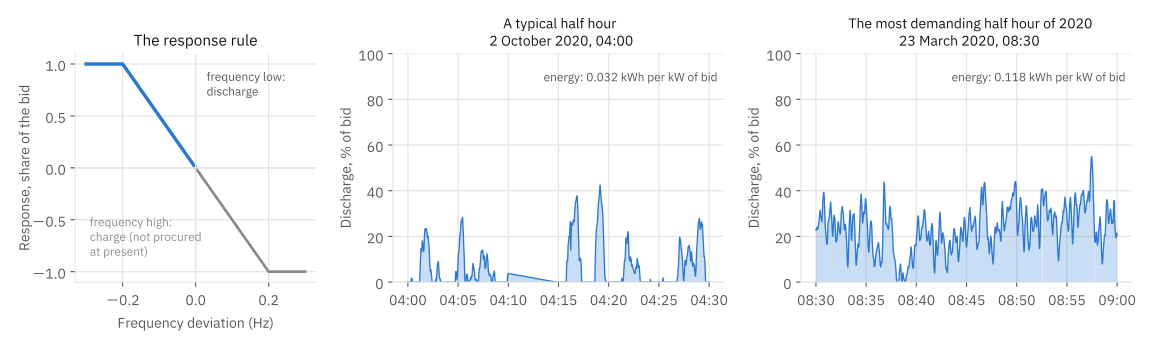
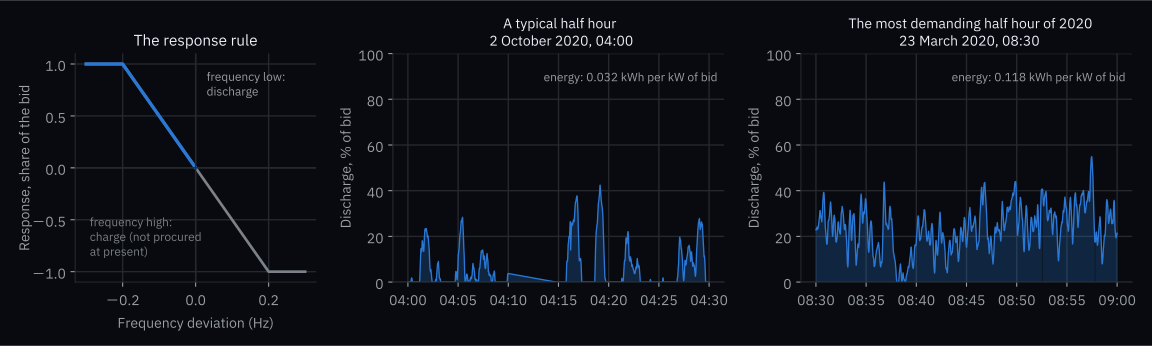
The offline primary reserve contract is expressed in kilowatts of response capacity, or ΔkW. The battery promises that when the frequency deviates from nominal, it will change its output in proportion to the deviation, reaching the full contracted ΔkW at a deviation of 0.2 Hz (0.3 Hz in Hokkaido). A 1,000 kW contract therefore means: at 49.9 Hz, discharge 500 kW; at 49.8 Hz or below, discharge the full 1,000 kW; at 50.0 Hz, do nothing. Figure 3, left panel, shows the rule. The mirror-image response, charging when the frequency is high, is technically identical but is not procured in Japan at present.
The output change depending on frequency is considered relative to a baseline level that the battery also needs to declare. In the case of a baseline at full charging power, the effective ΔkW that can be offered is equivalent to two times the battery’s power capacity, as the battery can respond to frequency deviation by first reducing charging, and in the worst cases start discharging. This is referred to as “nega-posi operation”, and it can be an interesting strategy since it effectively doubles the available response capacity.
Note that the contract does not determine how much energy the battery will deliver: that depends entirely on how the frequency behaves during the slot, which is the question the second half of this article answers.
What the market pays
A bid is defined by a ΔkW quantity and a price per kW per 30-minute slot. Accepted bids are paid their own price for the whole slot, independently of the frequency. The market itself makes no separate payment for the energy delivered. For a battery, the economics of the product are therefore almost entirely about the capacity price, and Figure 1 shows what it has been in the Tokyo area. Note that this is only valid for the primary offline reserve; other products have other rules and compensations.
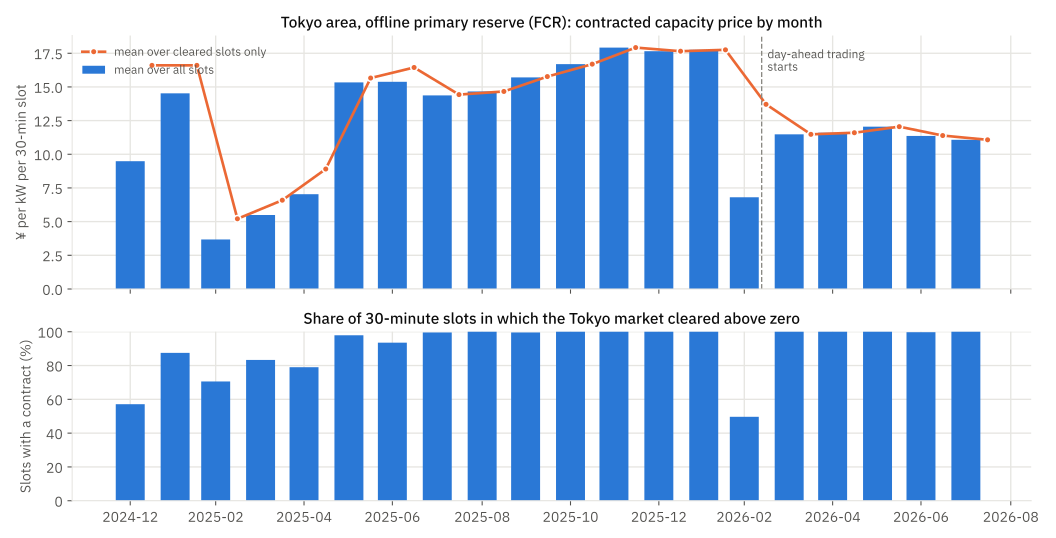
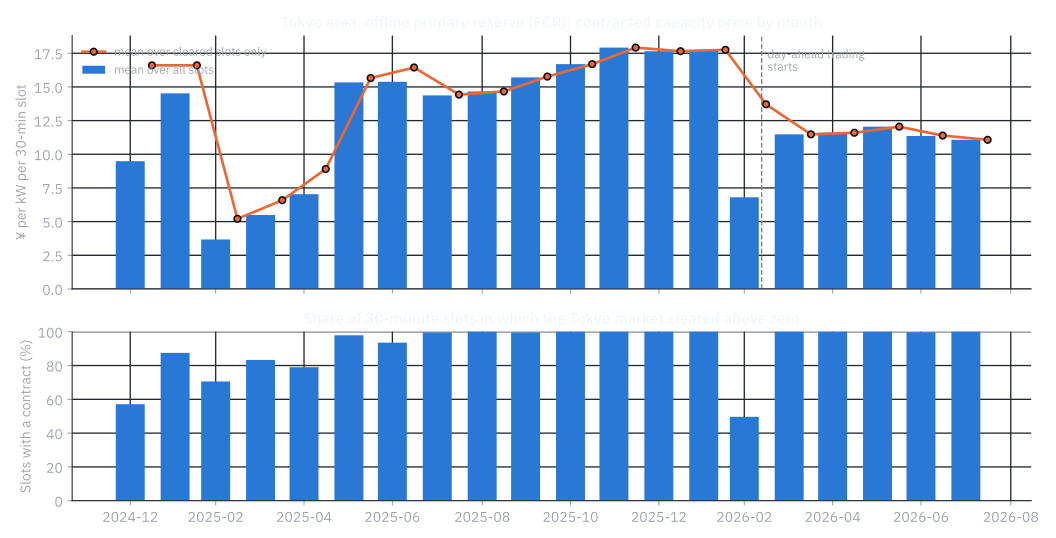
Once the market was established, FCR services were highly sought after and highly profitable. Tokyo procured FCR in nearly every slot: 92% of slots in fiscal 2025 and effectively all of them since April 2026. Prices in the weekly-trading era were close to the ¥19.51 cap for months, with a mean of ¥13.7 per kW per slot over fiscal year 2025. Once day-ahead trading and the lower cap were introduced, the price went down to a mean of ¥11.5 per kW per slot between April and August 2026. A contract of ¥11.5 per slot in every slot of the year is about ¥200,000 per kW per year; a 1 MW battery accepted at that price in every slot would earn on the order of ¥200 million a year. No battery holds a contract in every slot, and no bidder is accepted at the mean price every day, so this is an upper bound rather than a forecast, but it shows why primary reserve has dominated battery revenues in Japan since 2024.
Limitations of batteries for FCR and the operator’s problem
While a gas turbine providing reserve can respond for as long as it has fuel, a battery can only discharge what it has stored. A battery bidding on the reserve market must therefore hold enough energy in reserve to cover whatever the frequency demands of it during the contract, and it cannot recharge from the grid inside a committed slot without departing from its registered schedule, unless its bid was constructed around a charging schedule to begin with.
The naive answer is to reserve the worst case: enough energy to discharge the full ΔkW for the entire slot, 0.5 kWh per kW per half hour. But this is absurdly conservative. A grid whose frequency sat 0.2 Hz low for thirty minutes would be in the middle of a major emergency, which would likely not last that long before a recovery or a complete blackout. In normal operation the frequency deviates by more than 0.1 Hz only briefly. Reserving the worst case would lock up energy that could earn money elsewhere, and for a battery without grid charging, or a battery co-located with solar, it would make participation almost impossible. The practical question is: how much energy does a half hour of primary reserve actually use, and how bad can it get?
Analysis of one year of Tokyo frequency
To answer the operator’s question above, we took one full calendar year of grid frequency measurements for the Tokyo area, from 1 January to 31 December 2020, sampled every 0.5 seconds. After removing empty records and runs of more than three identical consecutive readings, which indicate a stuck measurement, 54.2 million samples remain, covering 86% of the year’s 17,568 half-hour slots to at least 80% completeness. Slots below that threshold are excluded from the per-slot statistics.
Overview
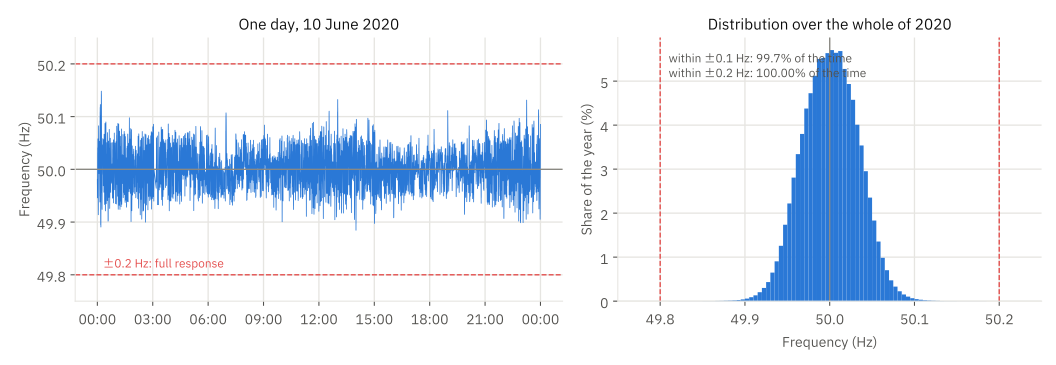
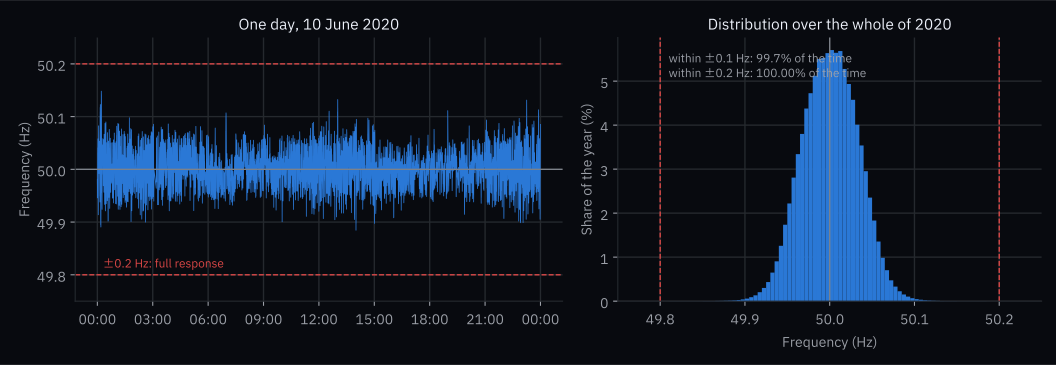
Over the year the frequency averaged 50.0008 Hz with a standard deviation of 0.033 Hz. It stayed within ±0.1 Hz of nominal 99.7% of the time. The lowest value recorded in the whole year was 49.808 Hz and the highest 50.193 Hz: the frequency never left the ±0.2 Hz band, and so never once demanded the full contracted response.
From frequency to energy
We apply the response rule to every sample: the required discharge, as a fraction of the contracted ΔkW, is the frequency shortfall below 50 Hz divided by 0.2 Hz, capped at 1, and zero whenever the frequency is at or above nominal. Averaging this fraction over each 30-minute slot and multiplying by half an hour gives the energy delivered per kW of contract in that slot, in kWh per kW. This is a simplification of a real energy management system (EMS): it assumes an instantaneous, linear response with no dead band and no ramp rate limit, which slightly overstates the energy and is the conservative direction for reserve sizing.
Energy per slot
| Energy per kW of contract, per 30-minute slot | kWh per kW |
|---|---|
| Mean | 0.032 |
| Median | 0.032 |
| 90th percentile | 0.045 |
| 95th percentile | 0.050 |
| 99th percentile | 0.063 |
| 99.9th percentile | 0.083 |
| Maximum (23 March 2020, 08:30) | 0.118 |
| Theoretical maximum (full response for 30 minutes) | 0.500 |
Table 2. Energy discharged by one kW of primary reserve in a 30-minute slot, Tokyo 2020, over the 15,062 slots with at least 80% data coverage.
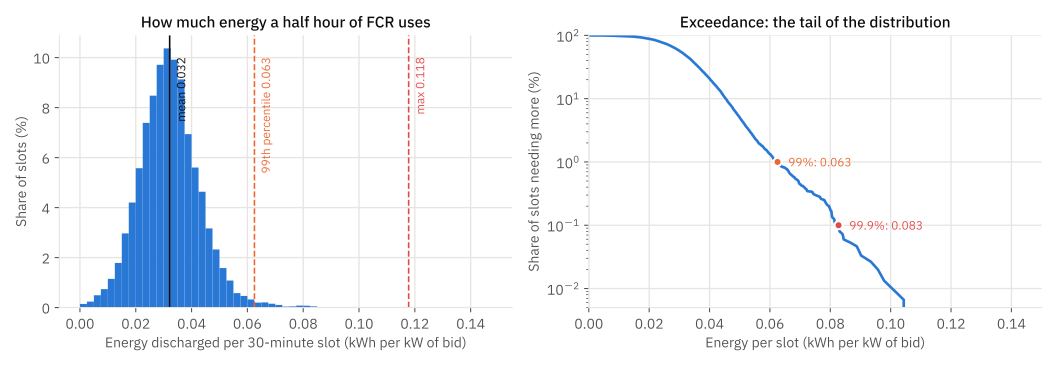
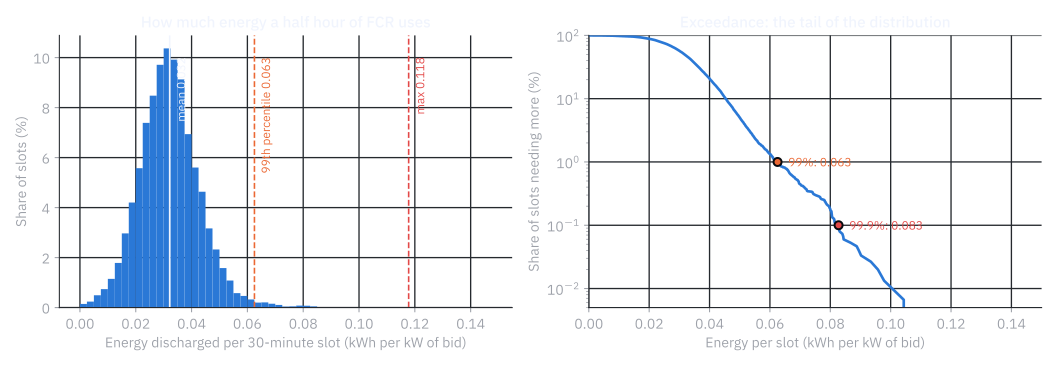
The typical half hour of primary reserve consumes 0.032 kWh per kW, one sixteenth of the theoretical maximum, and the distribution is relatively narrow: the 99th percentile is only twice the mean, and the worst half hour of the year needed less than a quarter of the theoretical maximum. For a battery with 1,000 kW of reserve, this means about 32 kWh per slot on average and 118 kWh in the worst slot of the year.
No significant daily or seasonal pattern
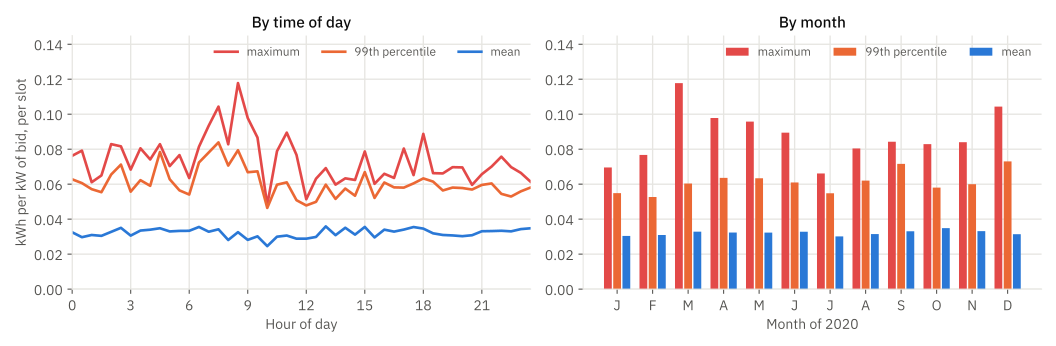
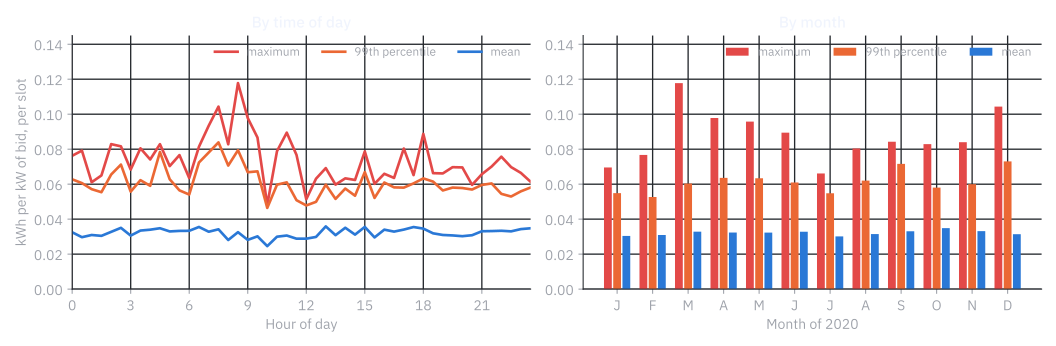
The data do not show a significant dependence on time of day or season. The mean per slot has no consistent daily shape and is almost identical in every month of 2020, and the worst slots of the year are scattered through the day and the year. For sizing purposes, the energy demand of primary reserve can be treated as the same at any hour and in any month.
How correlated are consecutive slots?
A battery rarely commits to a single half hour; contracts are typically held over several consecutive slots. What matters for the energy reserve is then whether a demanding slot tends to be followed by another one.
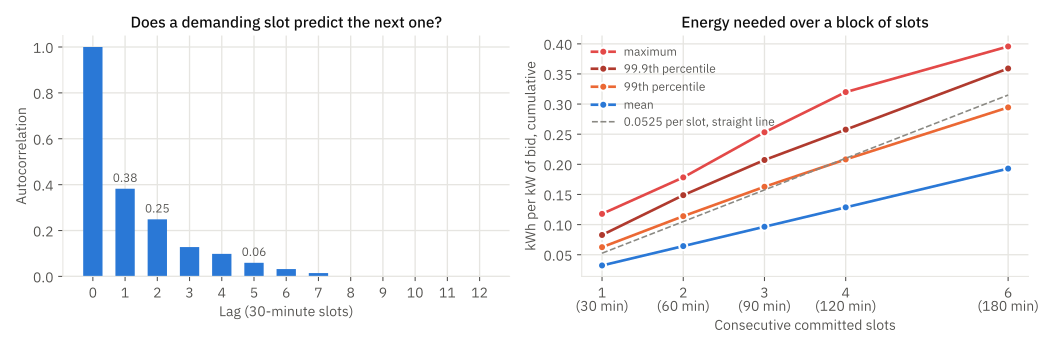
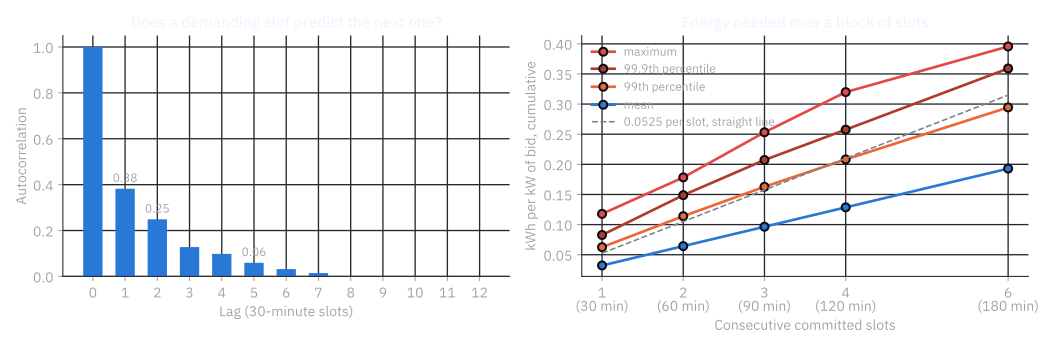
There is some persistence, but it is short-lived: the correlation between one slot and the next is 0.38, and it is effectively zero after about four hours. The consequence is that the energy needed over a block grows almost linearly with its length while the extremes grow more slowly: a six-slot, three-hour block never needed more than 3.4 times the single-slot maximum.
| Consecutive slots | Mean | 99th pct. | 99.9th pct. | Maximum |
|---|---|---|---|---|
| 1 (30 min) | 0.032 | 0.063 | 0.083 | 0.118 |
| 2 (1 h) | 0.064 | 0.114 | 0.149 | 0.178 |
| 3 (1.5 h) | 0.096 | 0.163 | 0.207 | 0.253 |
| 4 (2 h) | 0.129 | 0.208 | 0.258 | 0.320 |
| 6 (3 h) | 0.193 | 0.294 | 0.359 | 0.396 |
Table 3. Cumulative energy per kW of contract over blocks of consecutive slots, Tokyo 2020.
Implications for battery operators participating in FCR
Three things follow for an operator sizing a battery around the product.
- The theoretical worst case is way too conservative in practice. A battery with 1,000 kW of reserve and a 2,000 kWh store that commits to a three-hour block would, at the year’s worst, use 400 kWh, one fifth of its capacity. Any sizing rule based on the full-discharge case leaves most of the battery idle for no benefit.
- The energy is cheap relative to the capacity payment. At a day-ahead energy price of ¥15 per kWh, the 0.032 kWh that a kW of reserve discharges in a typical slot is worth about ¥0.5, against a capacity payment of ¥11 to ¥15 per kW per slot in the Tokyo market of 2025 and 2026. Even allowing for round-trip losses and battery wear, the energy side of the service costs a few percent of what the capacity side earns. The value of primary reserve to a battery lies in being available, not in the electricity it delivers.
- The distribution is stable, but the tail deserves consideration. Demanding slots are unpredictable and can draw several times the average: the year’s maximum arrived in a slot whose neighbours were unremarkable. A plan that budgets the average will be caught short by this tail unless an extra reserve is provided on top of it, and the tail may be heavier in other areas and years. Telemetry from one operating battery in the Kyushu area over eight months of 2025 and 2026 shows a median discharge in awarded slots of 0.031 kWh per kW, almost exactly the Tokyo figure, but a heavier tail, with a 99th percentile of 0.13 kWh per kW. This suggests that a margin above the 99th percentile of this study is prudent.
Our optimization and bidding algorithm takes these factors into account automatically when placing offers to EPRX, to minimize the probability of the battery not being able to deliver the awarded service. It weighs:
- the expected discharge from FCR;
- the physical limitations of the battery;
- simultaneous participation in the JEPX day-ahead market;
- the expected generation from solar, for colocated batteries.
In the extreme case of an expected shortage of energy or an expected battery unavailability, Tensor Cloud will automatically issue a cancellation order for the slots affected.
Limitations of this study
- The analysis rests on a single year, 2020, which included the reduced demand of the pandemic months; a year with a major generation loss would have a heavier tail.
- It uses Tokyo data only; the western 60 Hz grid, and Hokkaido with its ±0.3 Hz requirement, behave differently.
- The response model is an idealised, instantaneous droop with no dead band, which is close to what the product requires but not what any particular EMS does.
- The 14% of slots excluded for incomplete data were dropped without checking whether the gaps were random.
- The market data in Figure 1 are contracted prices; a bidder’s own revenue depends on its price and acceptance.
Conclusions
Keeping the grid frequency within a narrow band has always required a layered set of fast reserves, which before liberalization came for free from the governors of large rotating plants. As those plants retire, Japan has built a market to buy these reserves from batteries and other resources, and has been adjusting its rules and price caps ever since as batteries have entered in volume.
The offline primary reserve is ideally suited for batteries: it needs a fast, local, automatic response and nothing else, and it pays for availability rather than for energy. What the market rules leave open is how much energy that availability requires, and a year of Tokyo frequency data gives a clear answer. A kW of reserve discharges about 0.03 kWh in a typical half hour, rarely more than 0.06, and never more than 0.12, less than a quarter of the hypothetical full response over a slot. There is no time of day or season to avoid, and demanding slots do not come in long runs. A battery can commit most of its energy to other uses and still hold its reserve safely, provided it keeps a margin sized on the tail of this distribution rather than on the theoretical worst case.
Sources and notes
- Electric Power Reserve eXchange (EPRX), 需給調整市場の商品要件と取引スケジュール [Product requirements and trading schedule of the balancing market], 6th edition, 13 March 2026. Product table, minimum bid, response times, day-ahead schedule.
- EPRX, 需給調整市場かいせつ資料 [Overview of the balancing market], 2nd edition, April 2026.
- EPRX, 需給調整市場とは [About the balancing market], eprx.or.jp/outline. Market opening on 1 April 2021 and the staged introduction of products.
- Ministry of Economy, Trade and Industry, 需給調整市場について [On the balancing market], Working Group on Electricity Market Design, papers of 21 December 2022, 22 April 2024, 29 October 2025 and 23 January 2026. History of the public tenders from October 2016, product timeline, the 2026 move to day-ahead trading and the price cap reduction.
- EPRX, 需給調整市場のΔkW上限価格について [Upper price limits for ΔkW contracts], notices of 30 September 2024 and 30 July 2026. The ¥19.51 cap and the ¥10 cap in force from 1 September 2026.
- OCCTO, 一次調整力における供出可能量の考え方の見直しについて [Review of the deliverable quantity for primary reserve], 49th Balancing Market Study Subcommittee, 2024. Full response at a 0.2 Hz deviation (0.3 Hz in Hokkaido) within 10 seconds.
- Transmission system operators (10 companies), 現状のGFおよびLFCの運用について [Current operation of governor-free and LFC control], OCCTO working group, September 2020. Frequency targets of ±0.2 Hz and ±0.3 Hz and the ±0.1 Hz aim.
- Grid frequency data: Tokyo area, 1 January to 31 December 2020, 0.5-second resolution, 63.2 million records of which 54.2 million were usable. Timestamps are read as Japan Standard Time.
- Primary reserve prices: EPRX published contract results for the Tokyo area, per 30-minute slot, January 2025 to August 2026.
- On Japan’s two frequencies and the converter stations: Japan Times, “Japan’s incompatible power grids”, 19 July 2011; OCCTO cross-regional network plans for the Tokyo–Chubu interconnection.